Members of six fishing associations in Barrancabermeja and Puerto Parra, in Colombia’s Middle Magdalena region, are leading an effort to release Podocnemis lewyana, or Magdalena River turtles, that are accidentally caught during fishing activities. Throughout their fishing trips, every turtle caught in their nets is measured, tagged, and returned to the water. In the process, they are also gathering valuable information about the species. These fishermen have become sentinels for an emblematic species of the region, classified as Critically Endangered.
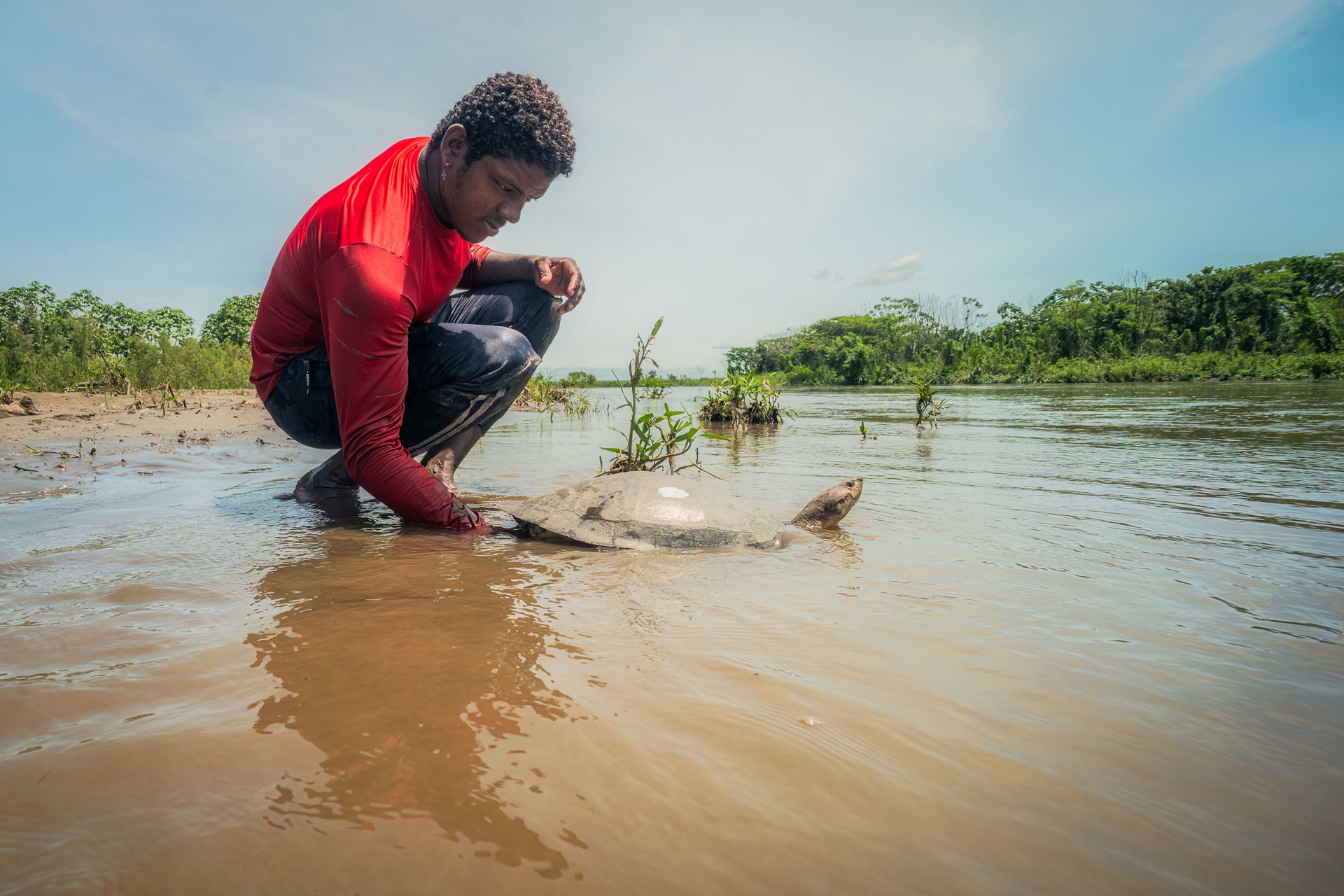 Photo: Jhonattan Vanegas
By Javier Silva
Luis Carlos Vera has good reason to be proud: at a time when wildlife and forests are under increasing pressure, he spends part of his time helping save a turtle that has long been emblematic of the Middle Magdalena region. Podocnemis lewyana has a remarkable distinction: it is endemic to Colombia, meaning it is found nowhere else in the world.
A few days ago, at sunset, after completing an almost 12-hour fishing trip on the Magdalena River near Bocas del Carare, a village in Puerto Parra, Santander, Luis Carlos was able to release eight turtles that had accidentally become caught in his nets during the demanding work of the day.
He said he was exhausted after dealing with the sun and cast nets, navigating through wetlands, and struggling to catch enough catfish to earn a good income. At the same time, however, he felt proud and more at peace with his work as a fisherman.
Historically, some fishermen who catch river turtles take them home to cook or sell them. It is a practice associated with tradition and, in some cases, with the need to make a living.
Luis Carlos, by contrast, now examines the turtles, measures their shells, tags them, and returns them to the river.
Through this work, he takes on another role: that of a community monitor. He contributes his local knowledge to an effort whose primary purpose is to protect turtles caught incidentally, release them, and thereby reduce pressure on their populations, while also generating information about the species.
“The turtle release effort is not, in itself, a monitoring program. It has two main objectives: the first is to release turtles caught incidentally, which directly reduces pressure on the species. The second, building on that work, is to monitor and document these releases,” explains Germán Forero, Scientific Deputy Director of WCS Colombia.
A Critically Endangered Species
The Magdalena River turtle is classified as Critically Endangered by the International Union for Conservation of Nature (IUCN), which places it in this category because its populations have declined by 80%.
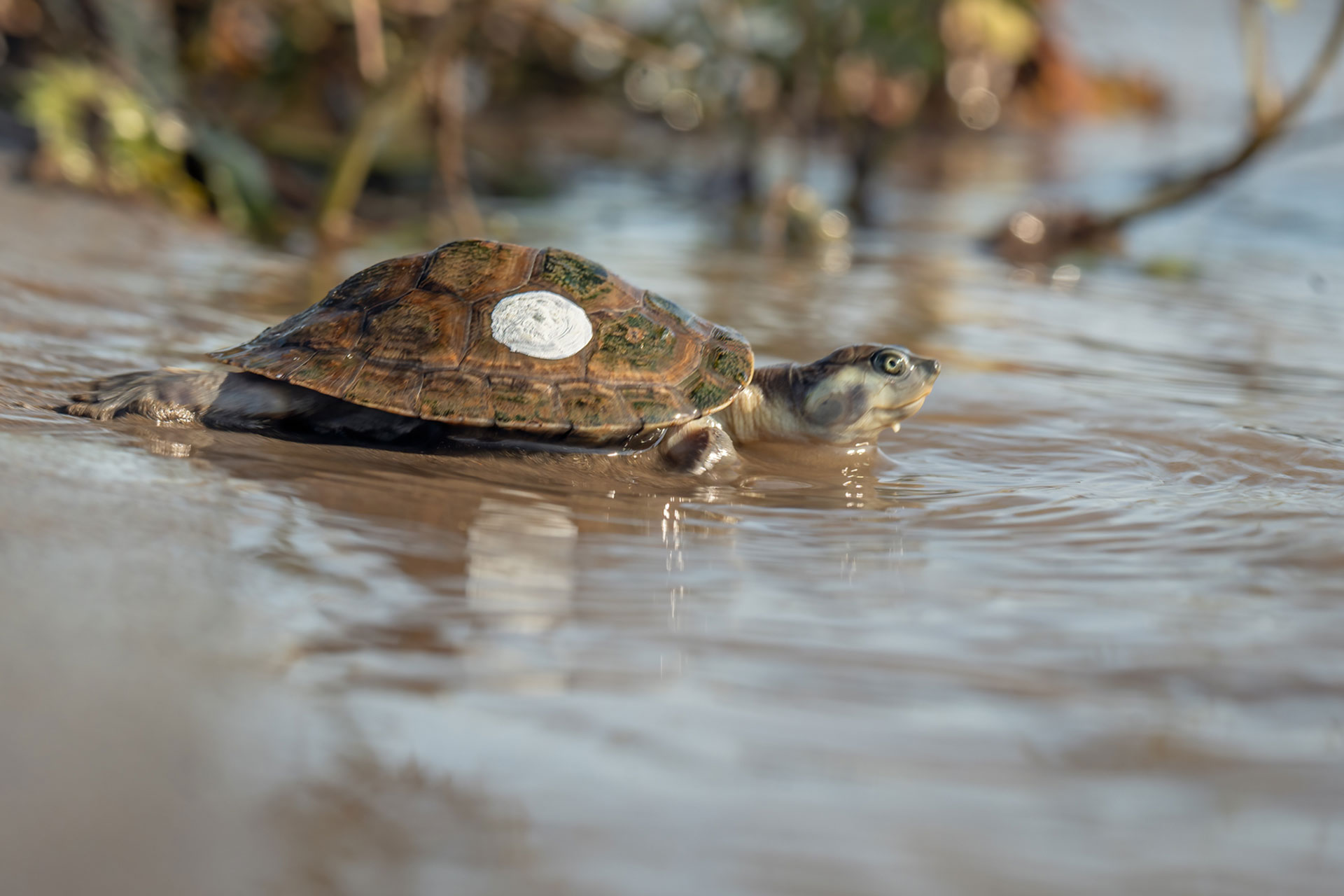 Photo: Jhonattan Vanegas
Across its range in the Magdalena River basin—which includes tributaries such as the San Jorge—and in rivers of the Caribbean basin, such as the Sinú, the species faces unsustainable commercial exploitation. Its eggs are consumed, and during Holy Week in particular, so is its meat.
The turtle also faces habitat degradation, particularly from the drying of sections of some wetlands to establish oil palm plantations and from pollution caused by industrial discharges into these ecosystems.
Associations Growing More Active
That is why Luis Carlos’s work, supported by Proyecto Vida Silvestre (PVS)* and Turtle Survival Alliance (TSA), has become a bright light amid the crisis. He is currently working alongside a total of 140 fishermen.
Yelsin Salgado, a PVS professional, says that enthusiasm for protecting the species has grown over time in the region. In 2023, 53 members of three associations began monitoring the species.
Today, six associations are involved: Asodesba, Apacco, Asopezgrum, and Pezcomagda in Barrancabermeja; Asopesbocar in Bocas del Carare; and Asopezchucurí in the village of San Rafael de Chucurí.
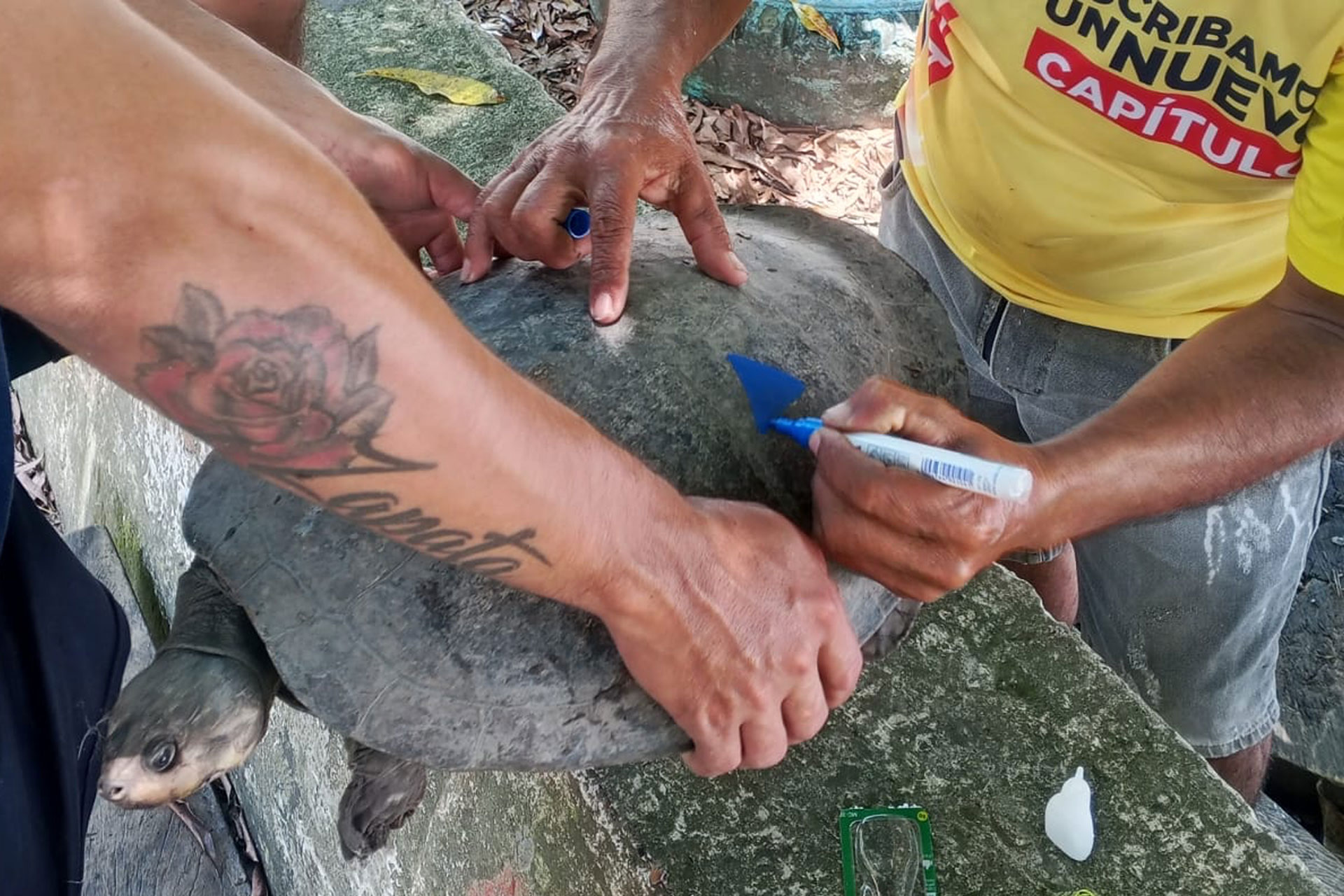 Photo: Oscar Caro / Asopezchucurí
The initiative took its first steps in late 2022, when a diagnosis was conducted on the relationship between local communities and the species. Based on this information, community monitors began their first field experience between January and July 2023; the work then continued from March to September 2024. A third phase began in March 2026 and continues today.
During their fishing trips, fishermen tag every turtle caught in their nets. For Asopesbocar, the association Luis Carlos belongs to, the mark is a white circle (a button of the same color is also attached to the shell). Asodesba uses a red square (or red button), while Asopezchucurí uses a blue triangle (or blue button). Other marks include a green diamond (Apacco), a gray rectangle (Asopezgrum), and a black trapezoid (Pezcomagda).
Fishermen must record or remember the date and location of the encounter, whether the turtle is male or female, the fishing gear being used at the time of capture, and the number of hours spent fishing. Before tagging and releasing the turtle, they measure the curved length of its shell.
Because some fishermen cannot read or write, all of them, without exception, are supported by female monitors who collect the data from those unable to record it themselves at the end of the day.
Some of them transcribe what other fishermen have written because the information can sometimes be unclear or disorganized due to the physical demands of the fishing trips, which take place under the sun, in the rain, or amid catches of fish of different sizes. The monitors also receive the figures orally from those who were unable to write them down and record them from memory.
Beyond collecting data and bringing together fishermen committed to a common cause, this process sends a direct message to communities about the need to value and take greater responsibility for their natural resources, especially now that the region, according to Colombia’s Institute of Hydrology, Meteorology and Environmental Studies (Ideam), could begin experiencing the first effects of the El Niño phenomenon, which causes a drastic decrease in rainfall in Colombia.
Luis Carlos says turtles are more visible when water levels are low or moderate—as they are now—when many fishermen in Barrancabermeja have to drag their canoes to reach the Magdalena River, as the water no longer reaches the riverbanks. The wetlands face a similar situation; in some areas, El Llanito wetland is almost completely dry.
“Seeing this has helped us become increasingly aware and draw the attention of many people, who are responding and following our example,” says Luis Carlos.
The information collected by the fishermen, as an additional benefit of the initiative, has also helped PVS professionals better understand the species and guide conservation efforts.
Active Reproduction
“Little by little, in the Middle Magdalena region, the turtle is no longer seen as something to consume or as an opportunity to earn money that sometimes cannot even be made through traditional catfish fishing. Instead, it is becoming a way to promote conservation,” Yelsin says.
Leonor Valenzuela, WCS Coordinator of Analysis and Synthesis, says they have encountered cases of fishermen who purchase captured river turtles and then release them.
“Avoiding consumption is a clear change that has spread quickly and become firmly established through active participation and the sharing of knowledge among communities,” she says.
She adds that between 2023 and 2024, 232 records were collected, including 130 females. Twenty-eight of them had curved shell lengths of more than 40 centimeters, indicating that they were adults.
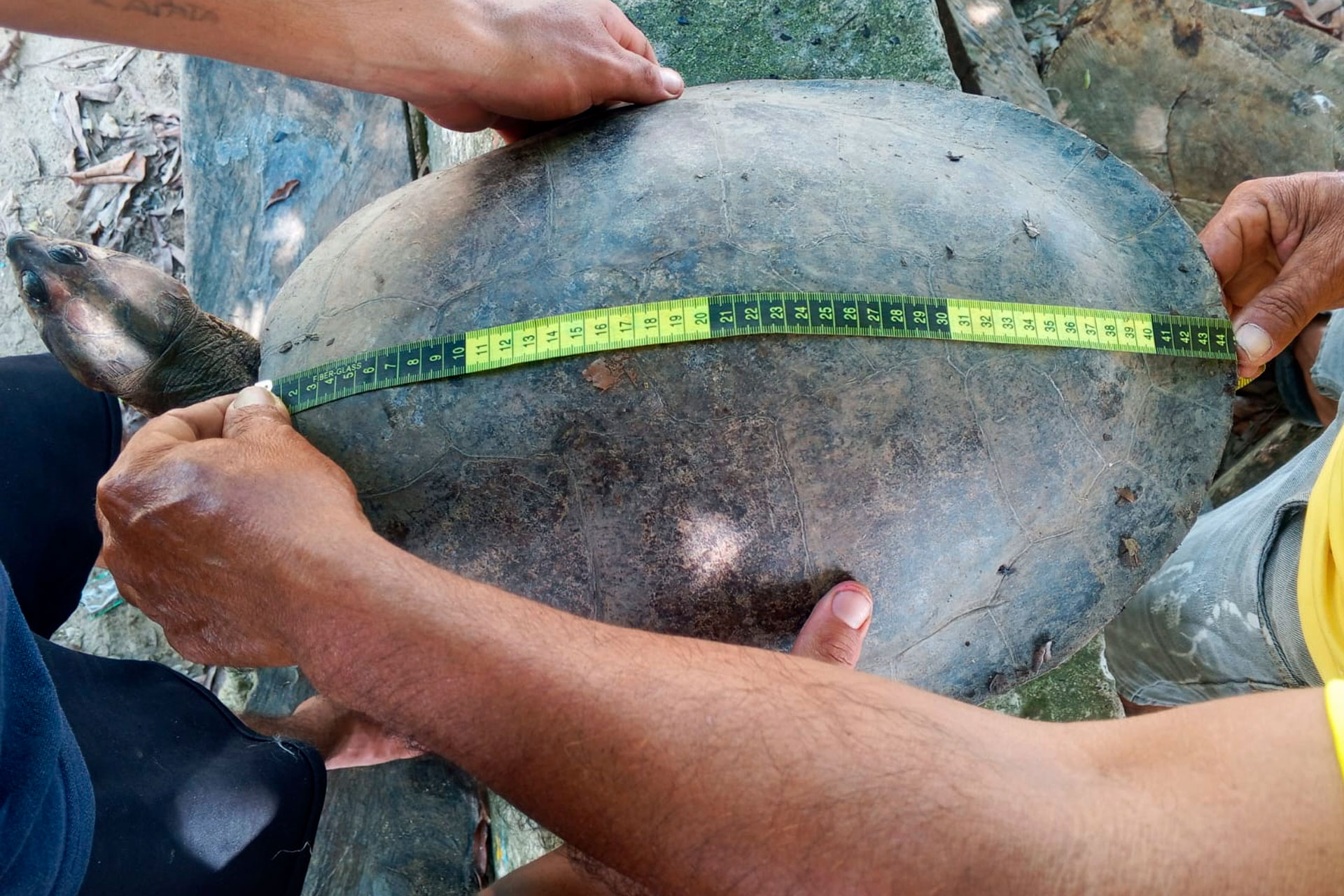 Photo: Oscar Caro / Asopezchucurí
In 2026, 251 turtle records have been collected, 249 of them involving incidental captures in which the turtles were subsequently released back into the river. Of these, 100 were juveniles, 81 were males, and 68 were females.
“The presence of juveniles is encouraging because it indicates that reproduction is active,” Leonor explains.
Analysis of the data has also revealed which types of fishing gear result in the most incidental turtle captures. These include the “rastrera,” a net weighing five arrobas (approximately 56 kilograms) and nearly 8 meters long; the “pastelera” or “pesada” (a 64-meter-long by 8-meter-wide net used to catch large fish); and cast nets.
These findings could help inform regulations on the use of certain types of fishing gear in specific locations or habitats, depending on water conditions in the Magdalena River.
The initiative has also helped identify sites where Podocnemis lewyana is most frequently recorded and which are also commonly used by fishermen. These include La Castilla-La Ganadera, Rincón El Clavo, Rincón de las Montoyas, El Guayabo, Los Morros, Caño Rúber, and La Caimanera. These are places where many of the nets that were once a potential threat have now become tools for protecting these unique reptiles.
And so we now know that if Luis Carlos and the other monitors continue traveling along the Magdalena River, these turtles will increasingly have the chance to encounter fishermen who, in addition to making their living from the river, have become their most devoted sentinels.
*For 10 years, Proyecto Vida Silvestre (PVS), an initiative led by Ecopetrol, Fondo Acción, and WCS Colombia, has worked to conserve several wildlife and plant species across three Colombian landscapes: the Eastern Plains, the Middle Magdalena region, and the Andean-Amazonian foothills of Putumayo