The publication explains how to properly identify species and contribute to their sustainable management in Colombia’s Pacific and Caribbean waters. It includes illustrations and distinctive features to facilitate identification, as well as information on common and scientific names and on less common species that may occasionally appear in catches.
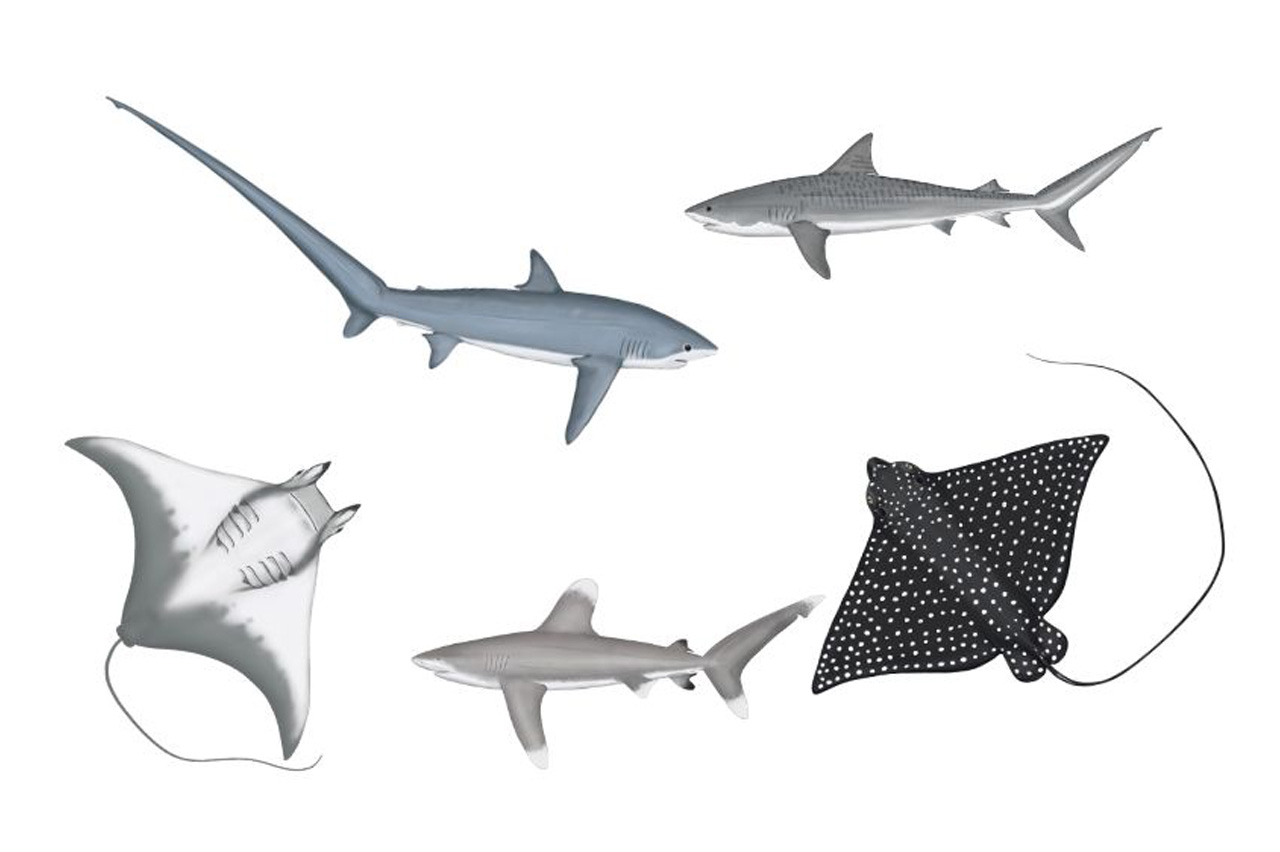 Illustrations: Iván Cortés
By Javier Silva
Colombia’s seas are home to 79 species of sharks and 65 species of rays, for a total of 144 species of elasmobranchs. Shark diversity is higher in the Caribbean, with 57 species, while 38 have been recorded in the Pacific. Among rays, 35 species have been identified in the Caribbean and 33 in the Pacific.
Both coasts share 16 species of large, highly mobile sharks, as well as two species of rays: the oceanic manta ray (Mobula birostris) and the largetooth sawfish (Pristis pristis).
This diversity of sharks and rays, found along two coasts with different ecological characteristics, highlights the importance of correctly identifying those that interact with fishing activities and generating reliable information to support their monitoring and management.
To address this need, Wildlife Conservation Society (WCS Colombia), Fundación Squalus, the German Development Cooperation (GIZ), the Directorate of Marine and Coastal Affairs (DAMCRA) of the Ministry of Environment and Sustainable Development, and the National Aquaculture and Fisheries Authority (AUNAP) have launched the updated guide, Sharks and Rays Incidentally Caught in Colombian Fisheries, designed to facilitate the proper identification of these animals when they are unintentionally caught in artisanal or industrial fisheries.
The publication reflects the approach of WCS Colombia’s marine program, which works directly with communities, particularly artisanal fishers in the Pacific, to promote responsible fishing practices.
The guide was prepared by researchers Andrés Felipe Navia, from Fundación Squalus, and Paola Andrea Mejía-Falla, from WCS Colombia. It is designed to be used even by people without specialized training in biology.
The document brings together information on the characteristics of species most frequently recorded in incidental catches. Each species profile includes illustrations and distinctive features to facilitate identification, as well as information on common and scientific names, maximum size, depth, geographic distribution, conservation status, and the types of fisheries with which they are commonly associated. It also includes a section dedicated to less common species that may occasionally appear in catches, in small numbers or as discards.
Although several species have been recorded in fisheries, around 29 shark species and 20 ray species interact more frequently with artisanal and/or industrial fisheries. In both cases, these figures do not include deep-water species occurring at depths greater than 200 meters, as there are no fisheries operating in these environments in Colombia.
Identification charts for field use
To complement the guide, the authors have also updated the shark and ray identification charts, designed as a simple and practical tool to facilitate species identification directly in the field.
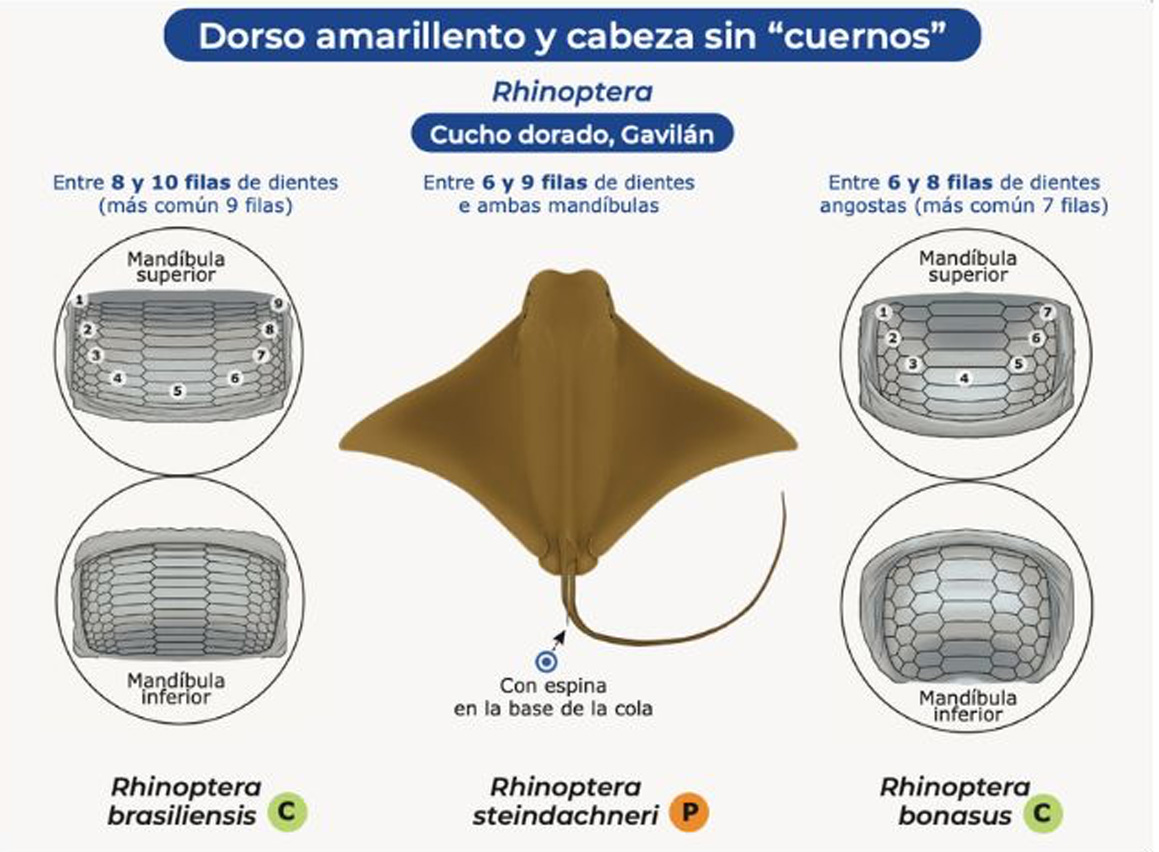 Illustrations: Iván Cortés
Using a series of easily observable external characteristics, such as body and head shape, the number and position of fins, the length and shape of the tail, and coloration patterns, among others, the charts guide users step by step toward identifying the species. For each species, they provide its common and scientific names, highlight other distinctive characteristics, and indicate whether it occurs in the Caribbean, the Pacific, or both regions.
Unlike the guide, which provides more detailed information on each species, the charts are designed for quick reference. Their compact format and printing on durable material make them easy to use during fishing trips, landings, monitoring activities, and other situations where sharks and rays need to be identified and recorded quickly and reliably.
Promoting good fishing practices
In Colombia, the use of fishing gear that catches multiple species results in incidental catches. Depending on the species, these catches are mainly used for local meat consumption and liver oil.
For this reason, the guide aims to strengthen monitoring programs, support the implementation of best practices for safe release, contribute to compliance with public policy instruments, and support both scientific research and participatory studies with communities.
One recommendation included in the document is to release captured animals alive whenever possible, prioritizing pregnant females and juveniles. This measure responds to the biological characteristics of many of these animals, including their slow growth and late maturity, which make them more vulnerable than other fish.
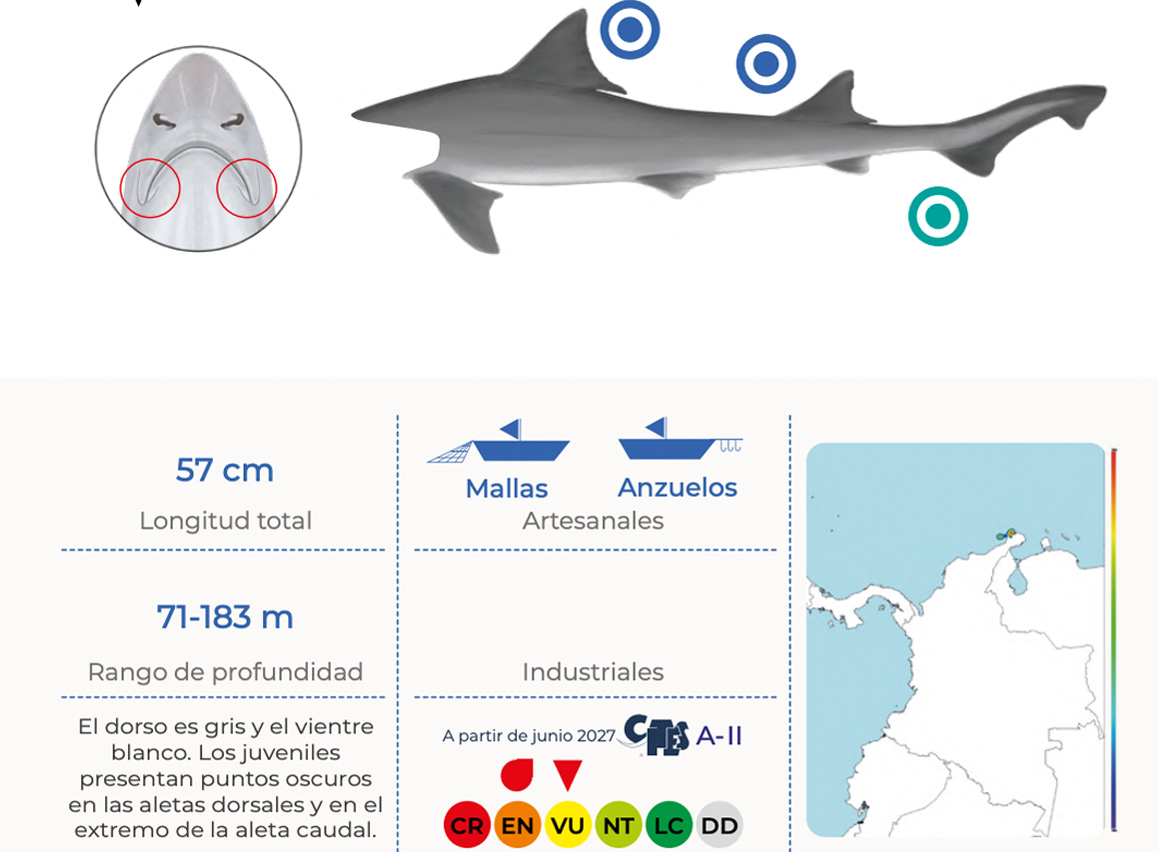 Illustrations: Iván Cortés
The guide also provides information on the conservation status of each species, both in Colombia and globally, and indicates which species are included in the Convention on International Trade in Endangered Species of Wild Fauna and Flora (CITES), an international agreement aimed at preventing trade from threatening species’ survival.
This information is provided for educational and reference purposes. However, it is important to note that fishing and the commercialization of marine sharks and rays, as well as their products and by-products, are prohibited in Colombia.
Paola A. Mejía explains that this publication updates and expands on the guide produced by the same authors in 2011, which included only species from the Colombian Pacific. “The guide and charts are expected to make it easier for those who collect or record fisheries information in the country to correctly identify shark and ray species and reliably record catches of these species”.
Paola Mejía adds that these tools can also support the identification and recording of species during biodiversity monitoring: “Correct species identification and reliable records are essential for making informed decisions about their management and conservation in Colombia”.
The document was developed with the support of the Save the Blue Five project, implemented by the Permanent Commission for the South Pacific, Conservation International, and Fundación MarViva, and funded by the German Federal Ministry for the Environment, Climate Action, Nature Conservation and Nuclear Safety (BMUKN) through the International Climate Initiative (IKI). It was also supported by WCS Colombia through funding from OceanKind, 30x30 Ocean Accelerator, Norad (Norwegian Agency for Development Cooperation – Fish for Development programme), and Bezos Earth Fund.